By Jim Waldron – Originally published in the 1990 Founder’s Review Magazine
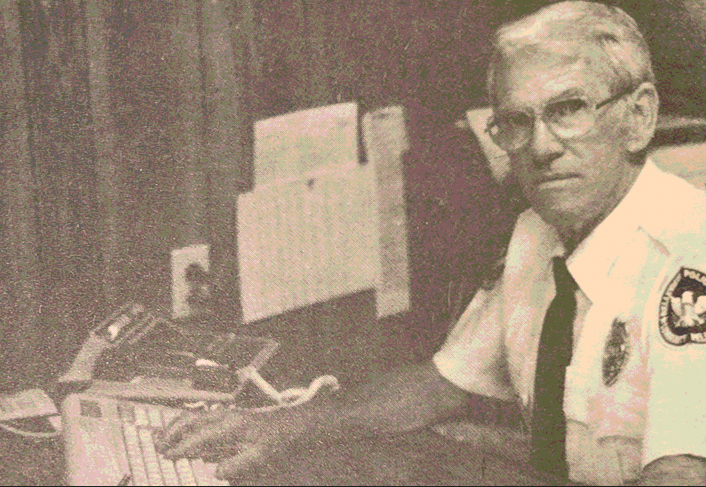
Bob Howie has the job of enforcing the law in Belleview—from traffic violations to zoning disputes to murders. He has been doing it for 18 years and is good at it. He is the Belleview Chief of Police.
In his 18 years carrying a badge in Belleview, Howie has faced just about every situation—from arresting Santa Claus to confronting armed men in a dark alley. “I stay in police work because I like it,” Howie said. “I like dealing with people, and it’s always something different every day.”
Being a policeman was all Howie ever really wanted to do. He graduated from Police Recruit School in his native Dallas, Texas, in 1955. He went to work as a policeman but found he couldn’t make ends meet on the $250 monthly salary. He moved to Florida and was working as an advertising salesman for the Ocala Star-Banner when he decided to get back into police work.
In 1972, he signed on as a security guard at Silver Springs on the four-to-midnight shift. That led to a part-time job with the Belleview Police Department. For almost two years, he worked two jobs: 4 p.m. to midnight at Silver Springs and the midnight to 8 a.m. shift for the City of Belleview. Howie was hired as a full-time officer in 1974 and accepted the top job in 1976 when then-Police Chief Bill Giles became City Clerk.
The Chief said there have been a lot of changes in the Police Department since the early 1970s. “Back then, the city leased its police cars,” Howie said. “We only had one car, and it was on the road all the time. We had magnetic signs for the side of the car that said ‘Belleview Police.’ When a car broke down, we would call the leasing company in Orlando, and they would send us another one—sometimes it was a sedan, sometimes a sports car.”
In 1972, the department had a Chief, two full-time officers, and one part-time officer. Today, the department has nine officers, two secretaries, and six cars. Belleview Police Officers include Bill Gunter, Les Batts, Terry Holland, Steve Ladd, Bobby Bostick, Billy Wilson, Lee Strickland, and Bill Giles. The secretaries are Gladys Prevatt and Rita Taylor.
There was a time when officers were hired, given a citations book, and told to start patrolling. Now, every officer hired by the Department must have completed basic recruit school and have two years of experience in law enforcement. Officers today receive a good salary, equipment, retirement, and other benefits while working for the City of Belleview. This improved package has stopped the previously rapid turnover of officers.
The addition of computers has significantly changed the department. Before computers, officers had to dig through files and paperwork to look up cases. Now, information is available in seconds. Computers also connect the Belleview PD with the Marion County Sheriff’s Department and the state. The Sheriff also has access to Belleview records. The next piece of equipment the department plans to purchase is a fax machine to receive photographs from other departments.
In past years, Belleview went through police chiefs quickly, hiring and firing new chiefs within weeks. Before Howie, the last four chiefs averaged only two years on the job. For 14 years, however, Howie’s work has pleased four mayors and dozens of commissioners, who seldom voice complaints about him publicly or privately.
“That part of it is simple,” Howie said with a grin. “I realize they are the boss, and I do what they tell me.” He added that the mayors and commissioners have been reasonable and easy to work with.
Howie believes the police are there to help in any way they can. “A resident might have a problem with a dog tearing up her flower bed. I know it doesn’t sound like much,” Howie said, “but it’s a big problem to her. We try to go and help solve the problem.”
Howie instructs his patrolmen to stay in touch with people and focus on preventing problems. Despite thousands of cars traveling through Belleview daily on U.S. 441, the police spend most of their time patrolling residential areas, where most traffic complaints originate. “We occasionally have someone flying through town at 70 miles an hour, but that’s unusual,” Howie said. “Most of the traffic on 441 is not a problem. The complaints come from residential areas about people driving too fast or recklessly. Usually, we stop that with heavy patrols for a couple of days.”
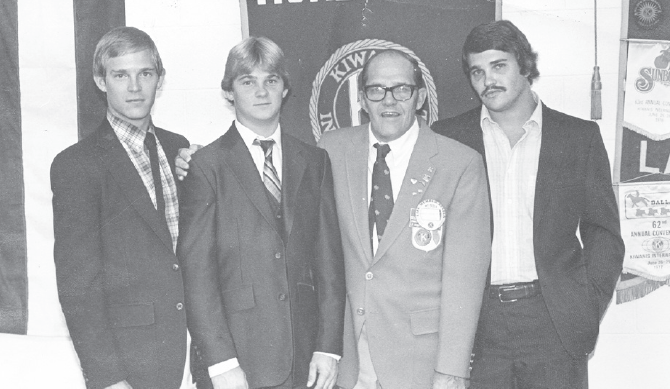
The Crime Watch program that Howie started with the Belleview Exchange Club has helped reduce and solve crimes in the city. The group meets monthly and recently took a field trip to tour the county jail.
Howie has worked hundreds of cases in his 18 years, but a few stand out. “One I will never forget happened on my first night of duty in Belleview. I had a call about a man lying on the ground in a business parking lot. When I arrived and examined the man, I thought he was having a heart attack and called for an ambulance. After a few minutes, his condition appeared to worsen, and I didn’t think he was going to make it. When the ambulance arrived, the driver walked over to the man, kicked him in the ribs, and told him to get up. My first thought was, ‘What kind of town is this—to treat sick people like that?’ But after a few seconds, the man stood up, made an amazing recovery, and walked off. The ambulance driver told me the man had pulled that ‘trick’ on people a couple of times a week. I found out later he was right.”
Howie’s approach to police work has paid off for Belleview. The city’s case clearance rate of over 30% is far above the national average of 20%. And Howie has no plans to change his career.
“It’s in my blood now,” he said.