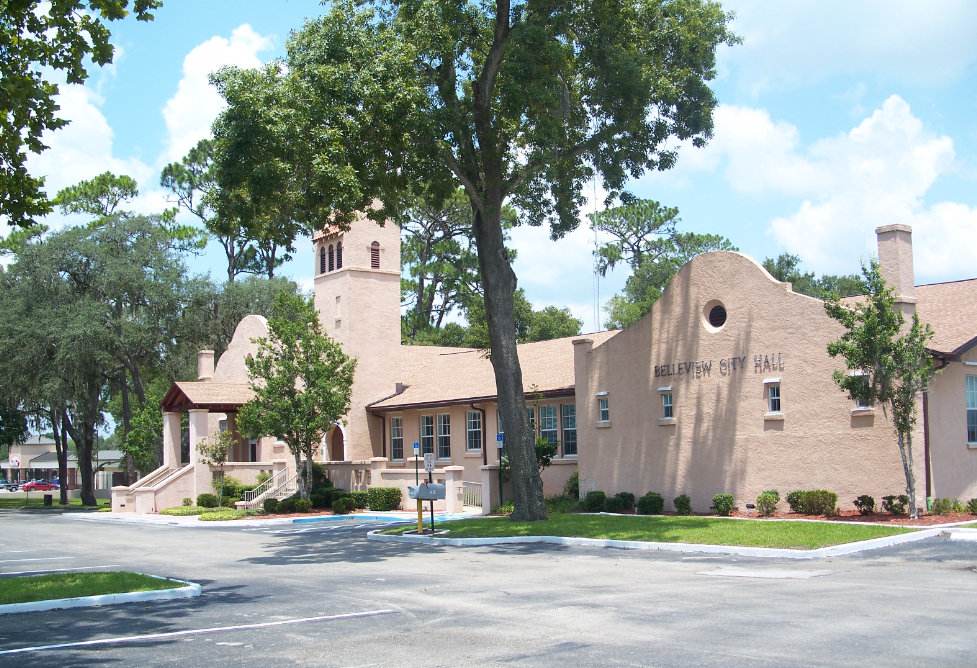
With a projected deficit of more than $330,000 looming over the City of Belleview’s general fund, the City Commission recently convened a budget workshop to grapple with tough financial decisions and scrutinize departmental spending. Like many American households, the City of Belleview is feeling the squeeze. Rising costs, from insurance premiums to everyday operations, are making it harder to stretch each dollar. Balancing the budget this year isn’t just a math problem; it’s a matter of priorities.
City Administrator Mariah Moody said the purpose of the workshop was to review the proposed budget and set the not-to-exceed millage rate, with Finance Director Strausbaugh on hand to answer questions.
A decline in building permit revenues drew early attention, with Development Services Director Chancey noting that residential construction has slowed but may rebound once site work is completed at Bellehaven, a planned 1,003-home residential development located near Baseline Road, expected to significantly boost permit activity once vertical construction begins.
The cost of insurance, from workers’ compensation to health and property coverage, was a major concern. Moody said the city has explored alternatives, but options within the existing consortium won’t be available in time for this budget cycle. Belleview’s small size, Moody noted, often puts it at the mercy of larger group plans, leaving few competitive options on the table.
Commissioners took a department-by-department approach, pausing to consider hiring freezes and spending constraints in light of the budget shortfall. The Finance Department was instructed not to fill any vacant positions and instead reorganize existing staff. The Police Department was permitted to fill its open roles, and Public Works was approved to fill existing and two new positions, all funded by a water/sewer fund. However, all other hiring tied to the general fund has been frozen.
Commissioner Ray Dwyer voiced concern about increasing salaries and pushed for a broader hiring review. To help curb spending, Commissioner Michael Goldman pitched cutting back on travel and training costs, recommending more webinars and fewer hotel bills.
Goldman also floated the idea of dissolving the Community Redevelopment Agency (CRA) to free up funds, but Strausbaugh warned that such a move would forfeit roughly $132,000 in county funding. The commission ultimately rejected the proposal.
Discussion also touched on whether to hand off the city’s portion of the Belleview Sports Complex to Marion County to save $50,000 in maintenance costs. No decision was made on that front. Some expressed concern that if the city gave up its share, the county might simply shutter the park altogether.
Despite the financial pressure, no commissioners supported a millage increase. Mayor Dobkowski proposed setting the not-to-exceed millage rate at 5.000, a motion made by Goldman, seconded by Commissioner Bo Smith, and passed unanimously by roll call vote.
The commission then reviewed bad debt from unpaid utility bills and discussed amending the city ordinance on residential deposits, including whether to discontinue refunding deposits after three years of timely payments.
The conversation also came just weeks after the city advanced Ordinance 2025- 06, a proposal to create an economic incentives program that would waive or reimburse impact fees and other costs for major commercial developers. While pitched as a way to attract investment and fill empty storefronts, the plan drew criticism for its potential financial strain, concerns that now feel amplified in light of the $337,000 budget shortfall. The workshop saw commissioners weighing hiring freezes, delaying raises, and even considering turning over city assets like the Belleview Sports Complex. The irony wasn’t lost: while the commission rejected dissolving the CRA to preserve $132,000 in county funding, it’s simultaneously moving forward with plans to forgo future revenue through development incentives.
Administrator Moody said a preliminary salary study revealed that several city positions fall below the recommended minimums. However, some commissioners expressed surprise at how high some salaries already are. One option floated was to move forward with the already budgeted 3% cost-of-living adjustment, while taking more time to analyze the full salary study. Mayor Dobkowski asked staff to calculate raise scenarios at 1%, 2%, and 3% for the next budget review.
Currently, starting pay for Belleview Police officers is around $53,000, while other local law enforcement agencies offer starting salaries closer to $63,000 to $65,000, a gap that could impact recruitment and retention.
More decisions are expected in the weeks ahead as the City of Belleview continues balancing financial reality with public service demands.