
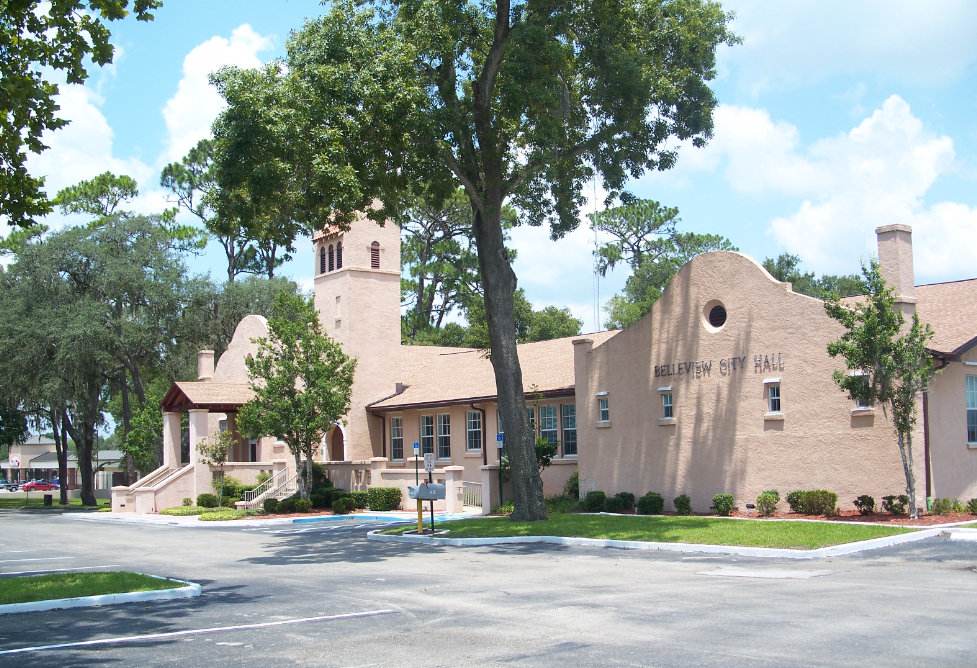
The City of Belleview is clearing more than $55,000 in unpaid utility bills from its accounting books after a review found weaknesses in previous collection procedures that could allow some delinquent accounts to continue accumulating charges.
The Belleview City Commission was presented with a request Sept. 1 to write off $55,228.26 in delinquent utility accounts from fiscal years 2024 and 2025. The action does not forgive the money owed to the city. Instead, the balances are considered uncollectible for accounting purposes, while the city retains the account information and may continue collection efforts.
Most of the delinquent accounts are for comparatively small amounts, often totaling less than a few hundred dollars. A handful, however, stand out.
The largest balance on the city’s list is $3,382.80 owed by Jose Santos Martinez for an account at 5086 SE 102 Place. Charles Hockaday has the second-largest balance at $3,077.33 for an account at 11136 SE 66 Terrace.
Palladio Development LLC has a delinquent balance of $2,268.47, making it one of the largest accounts included in the write-off as well. That company is also reportedly among the defendants in an ongoing federal lawsuit filed in October 2025 in the U.S. District Court for the Middle District of Florida. The lawsuit alleges violations of the federal Racketeer Influenced and Corrupt Organizations Act, commonly known as RICO.
Other corporate names on the city’s delinquent list trace back to one of the world’s largest companies.
Clayton Properties Group has a $1,165.28 delinquent account on the list, while Highland Homes appears on three additional accounts totaling $1,284.18.
Clayton Properties Group is part of Clayton, a Berkshire Hathaway company. Clayton acquired Florida-based Highland Homes in 2019, adding the builder to Clayton Properties Group. Together, the Clayton Properties Group and Highland Homes accounts total $2,449.46 on Belleview’s delinquent list.
Several other accounts exceed $1,000, including a $1,600.28 balance owed by Robert Hooper at 11136 SE 66 Terrace, a $1,304.14 balance owed by Brooke McGee at 10921 SE 51 Court, and a $1,134.45 balance owed by Robert Johnson at that same SE 51 Court address.
The size of those balances raises an obvious question: How did some utility accounts get thousands of dollars behind before service was interrupted?
City Administrator Mariah Moody said she could not definitively reconstruct what happened with every account, but a review by city staff identified weaknesses in previous procedures that could allow balances to continue growing.
“If an account was not processed timely for service interruption, additional usage and billing cycles could continue to accrue,” Moody wrote.
Customers moving without notifying the city to terminate service could also contribute to accumulating balances. The review came following changes in city staffing and leadership, when Administration, Finance, Utility Billing and Public Works examined utility billing concerns that had previously been raised by the City Commission.
The city has since established procedures more clearly defining responsibilities and requiring consistent monthly coordination between Utility Billing, Public Works and Administration.
Belleview has also expanded the way it warns customers who are falling behind. In addition to monthly bills and notices on the city’s website and Facebook page, customers with outstanding balances now receive text and email reminders about late fees, nonpayment fees and upcoming service interruptions.
Moody said the city has already seen fewer accounts reaching the service interruption list since adding the notifications.
Another weakness identified during the review involved customer deposits. Under the city’s previous policy, a deposit could be returned after three years of good payment history even though the customer’s utility account remained active. That meant the city could eventually be left without the deposit to apply against an unpaid final bill.
Commissioners changed that policy in February with Ordinance 2026-01. Deposits are now retained for the life of an account. Customers whose deposits had previously been returned must also reestablish a deposit if they are disconnected for nonpayment twice within a calendar year.
The city made another change through Resolution 26-01. The penalty for reaching nonpayment status was reduced from $60 to $50, with an additional $10 deposit collected when service is reconnected. Rather than the entire $60 functioning as a penalty, the additional $10 now builds the customer’s deposit and can eventually be applied against an unpaid final balance.
Moody believes the changes would have made a difference on the accounts now being removed from the books.
“Based on what we found during our review, I believe these measures would have prevented or substantially reduced a number of the larger balances we are now writing off,” Moody said.
The $55,228.26 total also represents more than a single year’s worth of delinquent bills.
Belleview historically carried utility bad debt for an extended period before writing it off. While preparing this year’s write-off, staff confirmed with the city’s auditors that there is no requirement to carry delinquent balances for three years and that accounts delinquent for more than 180 days may be considered for write-off.
The amount presented Sept. 1 covers two fiscal years and brings the city’s utility write-offs current through Sept. 30, 2025.
Going forward, Moody said the city does not intend to leave uncollectible receivables on its books for that long. And although $55,228.26 is disappearing from the city’s accounting ledger, it is not necessarily disappearing from what customers owe.
“An accounting write-off does not forgive the debt,” Moody said. “Those balances remain owed to the City and may still be subject to collection.”


