By Donald Hames – As Published in the 1991 Founder’s Review Magazine
Belleview, in 1843, was known as Long Swamp and Roach Pond, while Lake Lillian was referred to as Nine Mile Pond. In the 1860s, records show that Indians and soldiers danced together at the lake. The Stagecoach Line also passed through town, stopping at Roach Pond to exchange horses and gather water. The railroad arrived in 1882, and in 1884, the Marion Land and Development Company purchased land, selling off lots and acreage. Belleview was officially incorporated on May 4, 1885, under a charter granted by a special act of the legislature. At that time, there were 74 registered voters. Marion Land Company built a two-room school in 1885 near Lake Lillian, where the walking trail is today. Children attended school there until a new building, where Belleview City Hall now stands, opened in 1928. Some people recall attending school at the old wooden city hall between 1926 and 1928.
Belleview also had a college, which was started around this time in the home of a retired Harvard professor named George Bush. He had four female students who lived and studied in his home. The house still stands today at the corner of Front Street and Robinson Avenue. The Belleview Library was organized in 1886, also in Professor Bush’s home. The current building was completed and dedicated in 1908, with two new wings added in the 1960s.
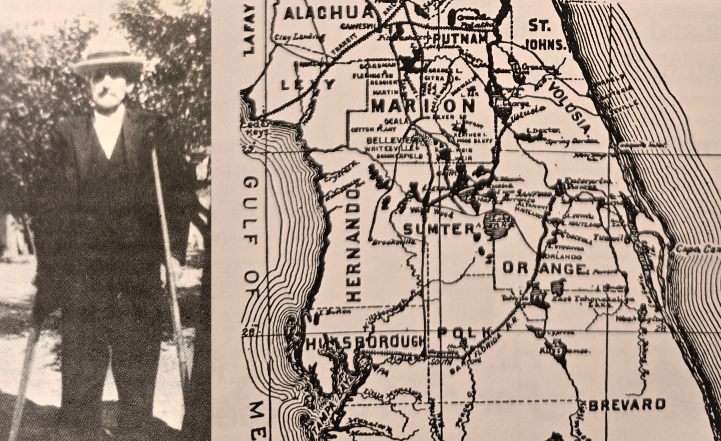
Donald Hames, a descendant of one of Belleview’s early settlers, grew up in Belleview, moved away as a young man, and recently returned to retire. He has been researching Belleview’s history and shares his findings in this article. Religious services were recorded as far back as 1884, with the First Baptist Church organized in 1889 and the First Methodist Church in 1900.
Belleview had a newspaper as early as 1889, with The Belleview Blade published by George P.E. Hart, and in 1900, The Belleview Newsletter. The Hotel Sanitaria was built in 1890, later becoming the Lakeview Hotel, and it still stands today.
There are two different stories about how Belleview got its name. One version suggests that John F. Pelot, one of the first settlers, named it after his daughter. The other story claims that someone in a church remarked on the beautiful view. You can choose which version to believe.
Names that appear in Belleview’s history include Pelot, Fogg, Robinson, Stetson, Hames, Dunn, Agnew, Bush, Babb, Penfield, Strong, Haviland, Dustin, Bauldorf, Weihe, Davenport, Rouse, Gale, Abshier, Cogswell, and many others. The Abshiers arrived in Belleview in 1886. Dr. Alfred Abshier was, at various times, the mayor, school teacher, postmaster, physician, and justice of the peace.
In the 1930s, 40s, and 50s, Belleview had three major fresh fruit packing houses that employed 250 to 300 people during the season. Do you remember when J.J. Smith hosted community peanut boilings each year? Or when the Bland family held cane grindings? Perhaps you recall when Burgess and Graham ran a garage and service station across from the railroad, or when J.R. Berckbicker had a poultry farm in the Cedars. There was also the Wilder brothers’ barber shop, Mrs. Fannie Heath teaching piano lessons, and Johnny Pierson’s dairy farm on 5th Avenue. Do you remember the dipping vat by the grotto for animals, or Bottleman’s sawmill where the current Bank is located? Or when Katherine Fheupce ran Kitty’s Restaurant, or Joe Williams had a restaurant and gas station? Maybe you recall Fred Stuart Greene’s art factory or H.E. Halderman’s brickworks, or Belleview’s pinball games at Smith Lake at the end of each year.
Belleview once had a turpentine still on Front Street and a large plant and meat processing house. Mrs. Lacy Belle Asso even taught first, second, and third grade at Belleview School. If you remember these things, you’ve been around for quite a while.
Other names in Belleview’s history include Amos Nott, the postmaster; John Harrell, the mail carrier; Eddie Armstrong, an attorney; Ed French, a real estate agent and notary; A.E. Ashworth, a school teacher; D.W. Dorothy, the jeweler; and George Ridge. The Hames name appears as far back as 1904.
We hope this article has shed some light on the history of “our town.”